TIMEPIX@school
Bringing detector technology developed
at CERN into classrooms worldwide.
TIMEPIX@school is a new initiative supported through the CERN & Society Foundation that will bring Timepix-based detectors, developed by the CERN Medipix2 Collaboration, into classrooms across the world. Following the success of a few pilot initiatives, a coordinated project will be launched for the first time in the academic year 2026–2027 and is estimated to reach 20.000 students by 2030. Particular emphasis will be placed on reaching schools in underserved and underrepresented communities, and engaging female students.
By giving students hands-on experience with the same technology used in high-energy physics, medicine, aerospace, and art, TIMEPIX@school aims to bridge the gap between the physics that is taught in school and everyday life, showcasing how science contributes to real-world societal challenges. By making science more accessible and relatable, the project will hopefully inspire a broader range of students to pursue STEM pathways, helping nurture a more diverse and inclusive STEM workforce.
At the same time, TIMEPIX@school will contribute to teachers’ professional development by offering them opportunities to diversify their teaching practice, strengthen their confidence in teaching modern physics, and deepen their subject knowledge.
The detector
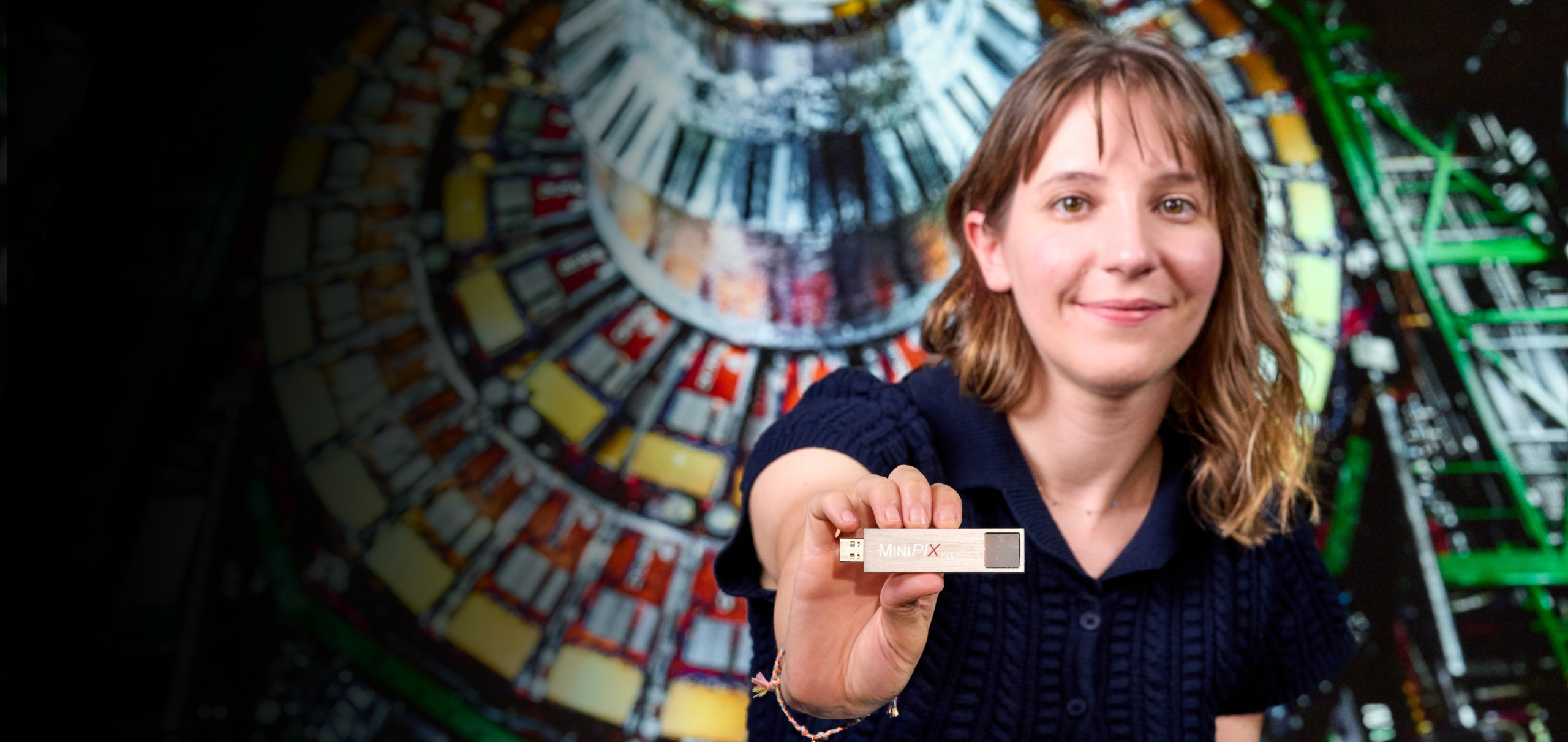
The Timepix chip is a silicon chip developed at CERN in the framework of the CERN Medipix2 Collaboration. The chip, that is more or less the size of a thumbnail, is divided into a 256×256 grid of tiny pixels.
The MiniPIX EDU detector is a compact, low-power radiation detector based on a single Timepix chip. The device connects to a computer via USB and works with user-friendly software, making it easy to integrate into classroom experiments. With the software, students can visualise radiation all around them, distinguish different types of particles (alpha, beta, gamma, cosmic rays, …), measure the energy they deposit in the sensor, and understand how they interact with matter. This provides a much richer experience compared to traditional Geiger counters.
The video shows a 60-second measurement of radiation emitted by charged decay products of naturally occurring radon in the air. These decay products have been collected on the surface of a balloon by charging it electrostatically.
Timeline
TIMEPIX@school is currently in its initial setup phase. The first full programme is planned to launch in the 2026–2027 academic year, with a small number of regional “hubs” (which can be schools, universities, institutes or research centres) that are based in one of CERN’s Member or Associate Member States. The programme is expected to expand globally in subsequent academic years. Institutions wishing to participate in future calls are invited to subscribe to receive updates.
Hubs will be selected through an open Call for Proposals that will be announced in May 2026. Selected hubs will receive a loan of up to 10 Timepix-based detector kits at no cost, as well as online training on the use of the kits. You can find more information on the programme model as well as the hub role and responsibilities here.

We anticipate to create approximately 5 hubs for the first year of the programme. This network is expected to be substantially scaled up for the next academic years, based on fundraising outcomes. However, we aim to offer to non-selected hubs meaningful ways to participate, including access to shared datasets, online activities, and interactions with scientists using Timepix-based detectors in different fields.
Pilot testimonials
“Thanks to the Timepix chip, I was able to discover how experimental physics works in a very accessible way for any sixth-form student. I think that bringing these tools to educational centres is necessary to create curiosity about STEM subjects amongst the youngest and make known the great world of particle physics, just as it happened to me.”
Claudia Santaella, student from Spain
“To have that confidence built at that age stood me in great stead as I was making decisions about my future. Not only was I inspired by all of the fascinating science that I learned through the experiments that we were able to conduct with Timepix, but I felt as though my peers and I could really, meaningfully contribute.”
–Anna Evans, student from the UK–
I have improved my teaching practice, and this is noticeable every day in the classroom: I can incorporate new activities, and I can go deeper into topics that I was initially completely unfamiliar with. In summary, an improvement both professionally and personally.
–
–
–Iolanda Huguet, teacher from Spain
Support TIMEPIX@school
TIMEPIX@school is made possible thanks to philanthropic donations through the CERN & Society Foundation, which enables individuals, companies and entities to connect CERN’s science with society.