About TIMEPIX@school
Learn about the programme
and its potential impact.
Pilot programmes
TIMEPIX@school builds on nearly two decades of national pilot initiatives using Timepix-based detectors in the classroom, which began when a school from the UK visited CERN in 2007. The experience gained through these initiatives has directly informed the design of TIMEPIX@school as a structured, scalable, and internationally coordinated programme.
For more information and inspiring testimonials on these pilot programmes, see Pilot Programmes.
TIMEPIX@school programme model
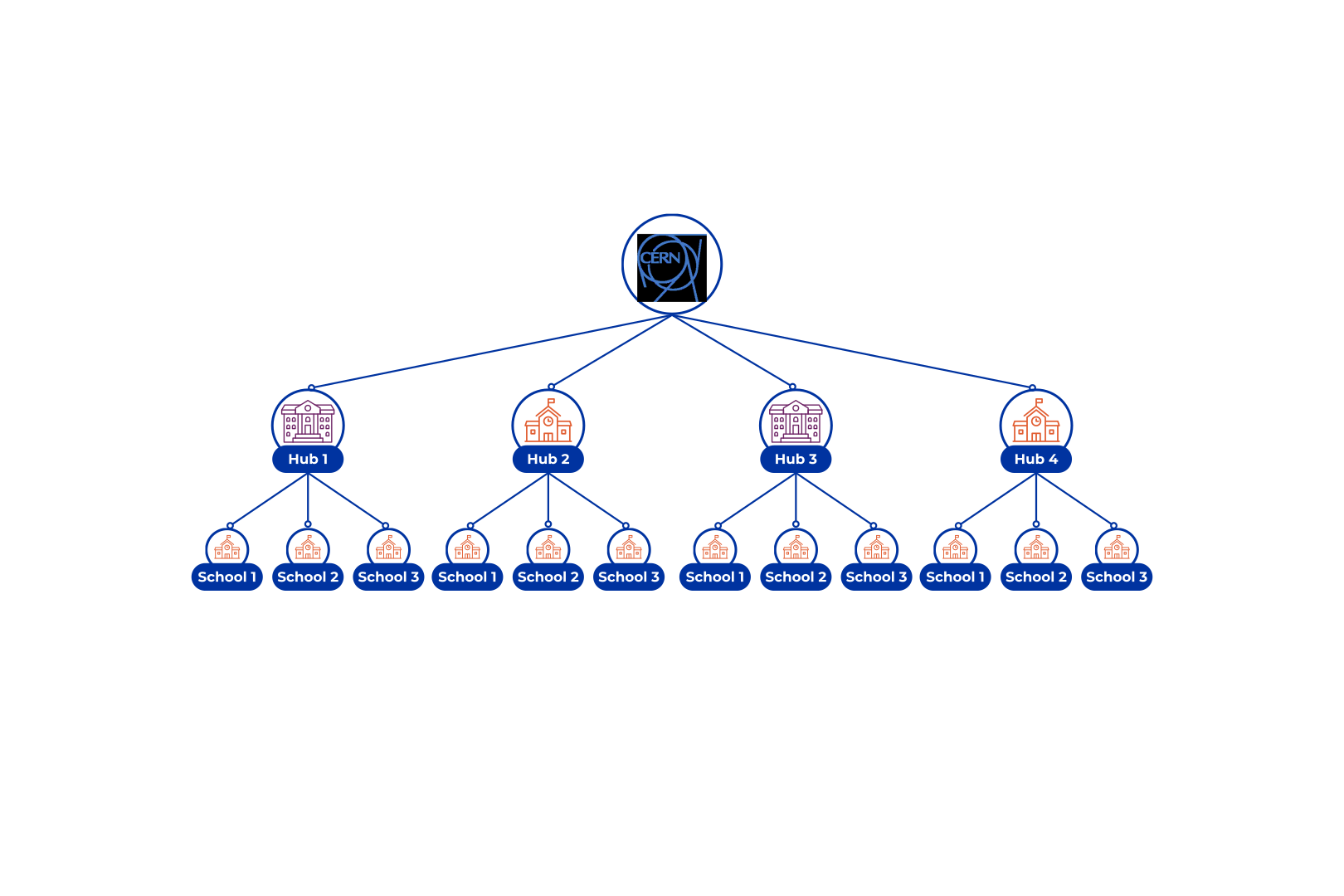
TIMEPIX@school will be based on a coordinated network of regional hubs located in schools, universities, institutes, or research centres. For the academic year 2026–2027, hubs will be selected across CERN’s Member and Associate Member states through a Call for Proposals that will open in May 2026. In subsequent years, the programme will expand globally.
Selected hubs will receive a loan of up to 10 Timepix-based detector kits at no cost and online training on the use of the kits. The role of the hubs will be to adapt and translate curated educational materials that will be provided by the TIMEPIX@school team to the local curriculum and distribute the detector kits and adapted educational materials to at least 3 partner schools in the area. In line with the project’s selection criteria, particular emphasis will be placed on reaching schools in underserved and underrepresented communities, and engaging female students.
Throughout the programme, hubs will serve as the main point of contact for partner schools, and as the main interface with the TIMEPIX@school coordination team at CERN. In addition, hubs will take part in a structured impact assessment process, which includes collecting student and teacher feedback through surveys over the course of the academic year. Its purpose is not to assess performance, but to document impact, celebrate innovative practices, and continuously improve the programme together with participating hubs and teachers.
TIMEPIX@school is built on the principle of co-creation. While CERN provides the detector kits, training, and a curated repository of educational resources, the heart of the programme lies in the creativity and expertise of participating hubs and teachers. Rather than prescribing a fixed curriculum, TIMEPIX@school is designed as a flexible framework that can be adapted to different educational systems, student interests, and local contexts. Hubs are encouraged to design interdisciplinary or project-based activities, develop new experiments and measurement campaigns, collaborate across schools or with local research institutions, and integrate the technology in ways that reflect their students’ curiosity and needs. Participating hubs and teachers are therefore active contributors shaping the evolution of TIMEPIX@school.
For curriculum topics and applications that can be addressed with these detectors, as well as examples of student projects carried out in pilot initiatives, see Curriculum links.
Impact
TIMEPIX@school is designed not only to introduce advanced detector technology into classrooms, but also to address ongoing challenges in STEM education, including students’ declining interest in STEM subjects, the need for meaningful teacher development, students’ misconceptions about radiation and radioactivity, and unequal access to advanced STEM opportunities.
Students’ interest & motivation
According to a report by the World Economic Forum, a global shortage of over 85 million skilled workers is estimated by 2030, with the largest gap in technology and engineering. This shortage is partly linked to a declining student interest in STEM subjects. TIMEPIX@school aims to help reverse this trend. Apart from inspiring future scientists and engineers, the programme seeks to foster positive and informed attitudes towards science among all students — future citizens who will need to navigate complex scientific and technological issues.
Research suggests that engaging students with hands-on, authentic STEM experiences, taking into account their interests, providing role models, and connecting learning to contemporary science can reignite their interest. In addition, previous studies indicate that students are particularly interested in topics related to radiation and radioactivity (Häussler et al., 1998), which have real-world relevance in fields such as medicine, space, industry, energy, and entertainment. By giving students hands-on experience with the same technology used in medical, space, and art applications, TIMEPIX@school aims to help students see the value and relevance of science and potentially inspire them to pursue careers in STEM. The effectiveness of Timepix-based detectors in fostering student interest and influencing their career aspirations has been clearly demonstrated by the CERN@school project in the UK (Parker et al., 2019).
Teacher development & motivation
Engaging teachers is a central goal of TIMEPIX@school. Through participation in the project, we aim to contribute to teachers’ professional development by providing them opportunities to enhance their teaching skills, diversify their teaching practice, increase their confidence in teaching modern physics and deepen their subject knowledge.
Hands-on work with Timepix-based detectors allows teachers to engage in authentic research typically reserved for scientists. They can explore topics across particle physics, dosimetry, medicine, chemistry, electronics, and data analysis, gaining practical experience with advanced technology and experimental techniques. This engagement not only deepens teachers’ subject knowledge but also inspires innovative classroom activities. In addition, teachers will gain access to the TIMEPIX@school network, connecting them with peers nationally and internationally to enable the exchange of ideas, resources, and best practices.
Students’ misconceptions
Radiation and radioactivity are two topics that are usually taught in school in a very abstract way. In many cases, the only relevant experimental exposure students receive is through a Geiger counter that produces a “click” when radiation is detected. While useful, this limited sensory experience often leads to students developing numerous misconceptions that have been reported in the literature, such as the belief that radiation is only artificial, misunderstandings about its origins and its constant presence in our natural environment, and limited awareness of its beneficial applications (see e.g. IOP misconceptions). A lack of understanding of modern physics concepts limits students’ ability to engage critically with societal issues involving radiation — from medical imaging and cancer treatment to nuclear energy and space exploration. As future citizens, their decision-making capacity is shaped by the scientific literacy they acquire in school.
Timepix-based detectors allow the visualisation of otherwise very abstract concepts. With those, students can visualise radiation all around them, distinguish different types of particles (alpha, beta, gamma, cosmic rays), measure the energy they deposit in the sensor, and understand how they interact with matter. Compared with traditional Geiger counters, these capabilities represent a significant qualitative improvement and have been shown to be extremely effective in addressing these common misconceptions (Parcerisas et al., 2025).
Inclusive & fair education
Women, people in rural areas, and those from socio-economically disadvantaged backgrounds are often underrepresented in STEM fields. TIMEPIX@school recognises that nurturing a diverse and inclusive STEM workforce is important, so it aims to widen participation in STEM by prioritising schools located in underserved communities and supporting activities that engage female students. By bringing students in contact with scientists, the project will challenge stereotypes that students might hold about scientists and show that modern science is creative and collaborative. This is particularly important for students who may not identify with the image of scientists presented by today’s media.
Finally, Timepix-based detectors, with their visual capabilities and hands-on approach, can support students across a wide range of learning profiles, from highly motivated and high-achieving students to neurodivergent learners and those with special educational needs. By enabling multiple ways of engaging with scientific concepts, the programme aligns well with the principles of Universal Design for Learning.
Sustainable development goals
TIMEPIX@school actively contributes to addressing 5 of the United Nations’ 17 Sustainable Development Goals (SDGs):
- Quality Education (SDG 4): Ensure inclusive and equitable quality education and promote lifelong learning opportunities for all
- Gender Equality (SDG 5): Achieve gender equality and empower all women and girls
- Decent Work and Economic Growth (SDG 8): Promote sustained, inclusive and sustainable economic growth, full and productive employment and decent work for all
- Industry, Innovation & Infrastructure (SDG 9): Build resilient infrastructure, promote inclusive and sustainable industrialization and foster innovation
- Partnerships for Goals (SDG 17): Strengthen the means of implementation and revitalize the Global Partnership for Sustainable Development
