
Call for proposals
Lead the next generation of young scientists
by bringing detector technology developed
at CERN into schools in your region.
Applications for the current call are now closed.
TIMEPIX@school is an educational initiative supported through the CERN & Society Foundation that will bring Timepix-based detectors, originally developed by the Medipix2 Collaboration at CERN, into classrooms across the world.
Launching in the 2026–2027 academic year, the project aims to bridge the gap between school physics and real-world applications by giving students hands-on experience with the same technology used in high-energy physics, medicine, aerospace and art. By 2030, TIMEPIX@school is expected to reach approximately 20,000 students.
For the first year of the programme, a small number of regional “hubs” (which can be schools, universities, institutes or research centres) based in CERN’s Member and Associate Member states will be selected through this open Call for Proposals. The reach of the programme is expected to expand across the globe in subsequent academic years. Institutions that are not eligible to participate in the 2026-2027 call are invited to subscribe for updates regarding future calls.
TIMEPIX@school is intentionally designed as a co-created programme. While CERN provides the technological and pedagogical foundation (up to 10 Timepix-based detector kits at no cost, online training on the use of the kits, access to a curated list of educational resources, and technical support), hubs have the freedom to design and adapt activities according to their local context. We rely on the expertise and creativity of hub coordinators and teachers to design interdisciplinary or project-based activities and measurement campaigns, collaborate across schools or with local research institutions, and integrate the technology in ways that reflect students’ curiosity and needs. Participation therefore extends beyond the use of the detector kits, with hubs actively shaping the programme through shared experiences and feedback.
The following sections describe the role of the regional hubs, the support they and participating teachers will receive, and the eligibility and selection priorities. Please visit the Technology web page to learn more about Timepix-based detectors and their applications in education, and the About TIMEPIX@school web page to learn more about the educational aims and programme model of TIMEPIX@school. For inspiration, you can explore the Curriculum links and student projects web page to learn about curriculum topics and applications that can be addressed with these detectors.
What is a hub?
A hub is a school, university, institute, or research centre which partners up with at least 3 schools (or 2 schools, if the prospective hub is a school itself) in its region and manages and distributes the detector kits and educational materials. Priority will be given to hubs that partner up with at least one school in an underserved community (for example with a high percentage of students from socio-economically disadvantaged homes or located in a rural area) or that place a strong emphasis on activities engaging female students in STEM activities.
What selected hubs will receive from CERN
Selected hubs will benefit from the following support by the TIMEPIX@school team:
- A loan of up to 10 Timepix detector kits at no cost for initially 1 year
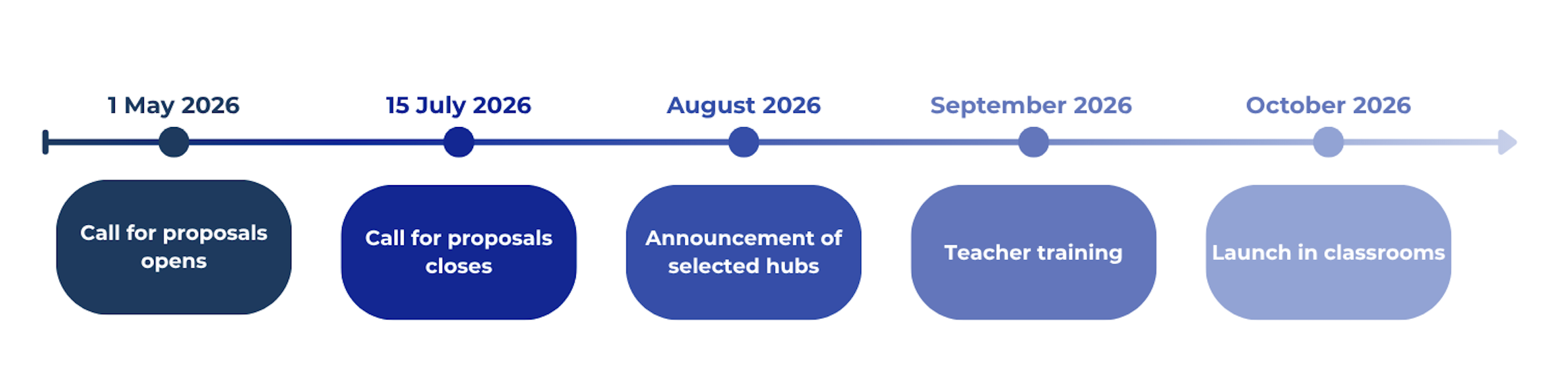
- Online training in English on the use of the detector and related software (approx. 2 hours in September/October 2026)
- Ongoing technical support by the TIMEPIX@school team (1—1 troubleshooting sessions and email support)
- Step-by-step tutorial videos on the use of the detector and related software, available on the TIMEPIX@school website as of September 2026
- Access to a curated repository of educational materials, available on the TIMEPIX@school website as of September 2026
- Institutional recognition as a TIMEPIX@school regional hub
- Opportunities to meet the scientists and users behind the Timepix technology, and to visit CERN
Please note that the support provided by CERN will be limited to the items listed above, and no additional financial contributions are foreseen.
Hub roles and responsibilities
Selected hubs are expected to:
- Adapt and translate the educational materials provided by TIMEPIX@school to the local curriculum
- Distribute the adapted educational materials and detector kits to at least 3 agreed partner schools in the area (or 2 schools, if the prospective hub is a school itself)
- Act as the first point of contact with partner schools, providing technical support, following initial online training from CERN
- Liaise with the TIMEPIX@school team at CERN to provide feedback on the programme’s development
- Contribute to the TIMEPIX@school community by sharing experiences, adapted educational materials, and detector data
- Contribute to assessing the programme’s impact by distributing teacher and student surveys to participating schools
- Ensure safe and responsible use of the equipment, and return it in good condition at the end of the loan period
Upon selection, successful hubs will be required to sign an agreement outlining the terms and conditions of participation in the TIMEPIX@school programme. This document will specify roles and responsibilities, loan conditions, detector use, as well as data management and protection.
Hubs have flexibility in how they organise collaboration with partner schools. For example, schools may use the detector kits at different times during the academic year, allowing a larger number of students to benefit. Activities can range from short classroom experiments to more extended student projects spanning a larger part of the year. Implementation may also vary across educational levels, from lower- to upper-secondary (typically ages 10-18), requiring adaptation in content and student autonomy. Applicants will be asked to describe their intended model of use in their proposal.
Implementation may also vary depending on the type of hub. School-based hubs may focus on collaboration between partner schools or may also choose to collaborate with local organisations such as science museums, science centres, or other educational institutions. Hubs based in universities, institutes, or research centres may additionally provide access to scientific facilities and opportunities to interact with scientists. Applicants are encouraged to make use of their institutional strengths and local context to enrich the experience for participating teachers and students.
What participating teachers will receive from CERN
Participating teachers will benefit from:
- Opportunities to enrich their teaching practice through modern, engaging and application-oriented activities developed within the TIMEPIX@school framework
- Access to the TIMEPIX@school Teachers’ Network for peer exchange and support
- Opportunities to meet the scientists and users behind the Timepix technology
Selection criteria
Eligibility
For the academic year 2026-2027, applications to become a TIMEPIX@school regional hub are open to schools, universities, institutes, or research centres that are based in one of CERN’s Member or Associate Member States. Each application must include:
- A designated hub coordinator responsible for project implementation and liaison with CERN
- A committed hub team with the capacity to provide technical support to participating schools
- A list of at minimum 3 agreed partner schools in the local area (or 2 schools, if the prospective hub is a school itself)
- A realistic and well-articulated plan for implementing the educational activities across the academic year
Priorities
In the selection process, priority will be given to proposals that demonstrate:
- Partnership with publicly funded schools, schools with a high percentage of students from socio-economically disadvantaged homes, or schools located in rural areas
- A clear focus on broadening participation in STEM, through activities that actively engage female students and students in underserved communities
- Motivation of the hub team, demonstrated through a strong commitment to the programme’s objectives, a proactive approach to engaging partner schools, and a willingness to take ownership of the local implementation and contribute to the programme’s development
- Creativity in programme design, for example through inter-school collaboration, shared measurement campaigns, or partnerships with local institutions
Additional considerations
Previous experience with Timepix-based detectors is not required and will not be considered a prerequisite.
Proposals will be assessed with the aim of ensuring geographical diversity and a balanced representation of contexts across the programme.
Beyond the 2026-2027 selection round
Due to the limited number of hubs that can be supported in the first pilot year of the programme, not all high-quality proposals can be selected. However, TIMEPIX@school aims to build a broad and inclusive community of practice. We are working to create opportunities for institutions that are not selected this year to participate in online activities or get access to data suitable for analysis in classroom settings.
We warmly encourage all interested institutions to remain connected to the TIMEPIX@school community by subscribing for updates and to apply in future calls as the programme expands.
Frequently asked questions
Is my institution eligible to participate in the programme?
Only schools, universities, institutes, or research centres are eligible to apply to the TIMEPIX@school programme. For the academic year 2026-2027, hubs must be based in CERN’s Member and Associate Member states. The reach of the programme is expected to expand across the globe in subsequent academic years. Institutions that are not eligible to participate in the 2026-2027 call are invited to subscribe for updates regarding future calls.
Please consult the “Hub roles and responsibilites” section to make sure your institution has the capacity to fulfil the requirements of the programme. This includes coordinating with partner schools, managing and distributing detector kits, providing basic technical support following training, and actively contributing to the TIMEPIX@school community through feedback, resource sharing, and participation in programme evaluation activities.
How can my school participate in the programme?
There are two possible ways for your school to take part:
1. Apply to become a hub: your school would receive detector kits and work with a small network of partner schools in your area. In this case, your school will also be able to use the kits and take part in the activities.
2. Participate as a partner school: if another institution in your region applies as a hub, your school could join their network and take part in the activities.
How many schools must a hub partner with?
In the application form, potential hubs will be asked to indicate at least 3 schools (or at least 2 schools, if the hub itself is a school).
Which student age range is the programme designed for?
TIMEPIX@school is designed for students between the ages of 10 and 18 years old. This corresponds to both lower and upper secondary education levels, depending on the national education system. The activities are intentionally flexible to allow adaptation across this broad age range in terms of content and student autonomy.
For younger students, activities can be more guided and focus on observation and inspiration, with simplified experiments and supporting materials. For older students, the programme enables more advanced investigations as well as independent or group research projects. Applicants will be asked to describe their intended model of use in their proposal.
What if my application is not selected?
We are working to create opportunities for institutions that are not selected this year to participate in online activities or get access to data suitable for analysis in classroom settings. We encourage you to subscribe for updates to remain connected to the TIMEPIX@school community.