Pilot programmes
Learn about the history of Timepix
in education and its impact on students.
History
TIMEPIX@school builds on nearly two decades of initiatives that introduced Timepix-based particle detectors into educational environments across Europe.
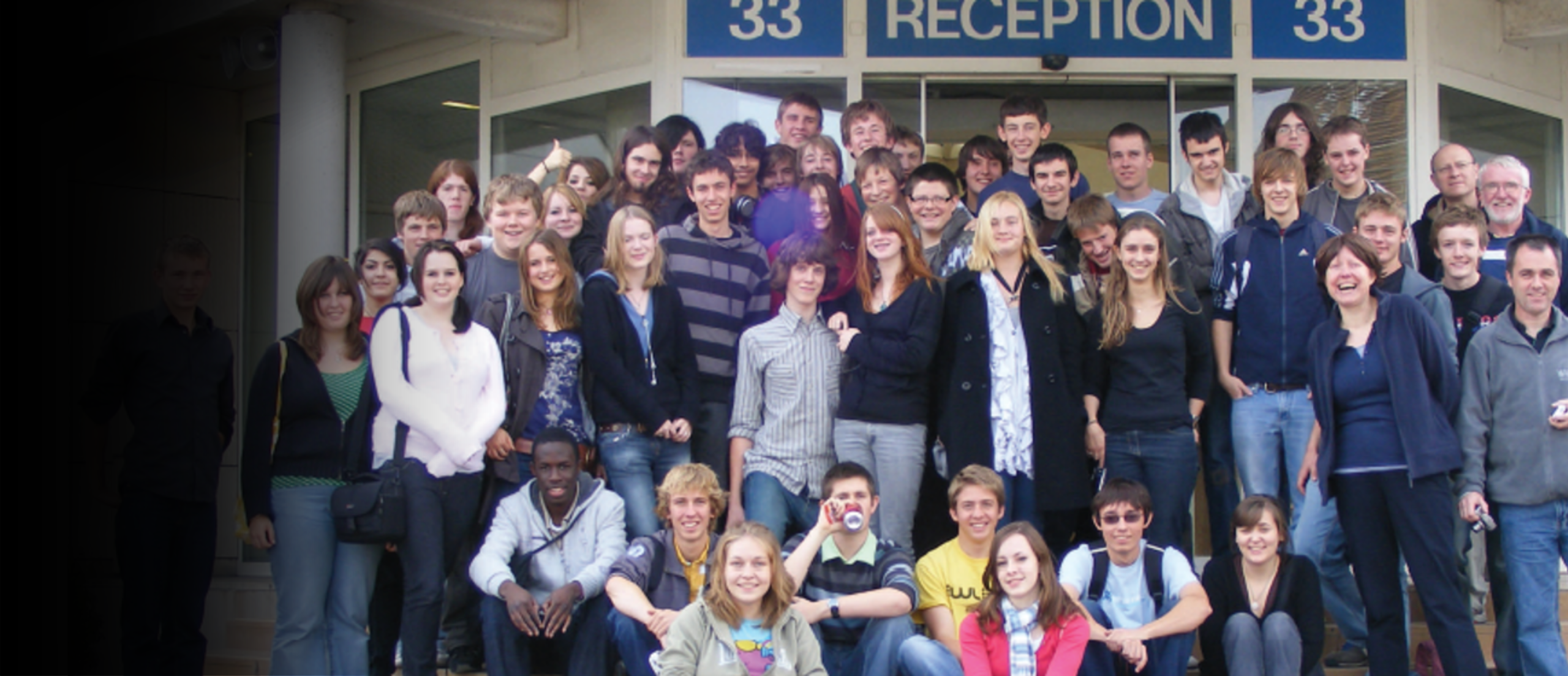
The first step came in 2007, when a school visit to CERN from the United Kingdom inspired the idea of bringing this detector technology into classrooms. Following that visit, the Institute of Experimental and Applied Physics (IEAP) at the Czech Technical University in Prague, with instrumental support from Stanislav Pospíšil, lent compact readout systems to Becky Parker who started using them in classrooms with her students. This led to the creation of the CERN@school programme, coordinated by the Institute for Research in Schools (IRIS) under Becky’s leadership. Through CERN@school, secondary school students used Timepix detectors to investigate ionising radiation, analyse real scientific data, and design their own experiments and launch measurement campaigns. The Langton Ultimate Cosmic Ray Intensity Detector (LUCID) project was a student-led space experiment on the TechDemoSat-1 that used Timepix detectors to measure the radiation environment in low Earth orbit, collecting data from 2014 to 2017. LUCID, supported by a Science and Technology Research Council (STFC) research grant, was featured on the CERN website and its results were presented in a scientific publication. TimPix, another student-led project, analysed radiation data collected on the International Space Station during the mission of ESA astronaut Tim Peake, and has been featured on a CERN article and on an IRIS article.
At the same time, the IEAP played a key role in adapting Timepix technology for education focusing initially on schools and universities in the Czech Republic. IEAP developed teaching materials, experiment guides, and teacher training activities that enabled the detectors to be used in schools, science centres, and museums.
The Prague-based company ADVACAM, which holds a licence to commercialise Medipix and Timepix technology, later introduced the MiniPIX EDU camera. These detectors were designed as educational devices and are accompanied by experimental kits and teaching resources suitable for schools and universities.
Further initiatives soon emerged across Europe. In 2017, the ADMIRA project, led by Daniel Parcerisas, was launched in Barcelona through collaboration between the University of Barcelona, and the Sagrada Familia School. The programme now connects about thirty schools in Catalonia and supports student research projects using Timepix detectors while encouraging collaboration among teachers and providing professional development opportunities. Similar initiatives have also developed in Italy at the University of Ferrara (led by Cristina Trevissoi), and in Spain with projects MEDRA (led by Cristina Cabo)and MadPIX (led by Francisco Barradas Solas).
Together, these initiatives have demonstrated the strong educational potential of Timepix-based detectors. They have shown that when students are given access to authentic research tools, they can investigate real scientific questions, analyse data, and present their findings in research-style formats. These experiences help strengthen conceptual understanding of radiation physics, address common misconceptions, and increase students’ confidence and interest in STEM. Teachers have also reported increased motivation and professional satisfaction through closer engagement with contemporary research.
Student testimonials
To have access to such exciting technology that enabled us to be part of genuinely impactful experiments was so empowering. Aside from the excitement of learning concepts that went well beyond the curriculum, it also gave me and others that I would certainly not have otherwise had.
To have that confidence built at that age stood me in great stead as I was making decisions about my future. Not only was I inspired by all of the fascinating science that I learned through the experiments that we were able to conduct with Timepix, but I felt as though my peers and I could really, meaningfully contribute. It was a completely unique experience and I am very grateful.Anna Evans, Data Analyst, UK
I had the opportunity to use a Timepix detector for my research project, about the effect of radiation on the growth of living organisms, in this case, plants. The two things I liked the most are its simplicity and versatility: it’s very easy to handle and it can be used for countless things. It has been a very interesting and instructive experience.
Efran García, Biomedical Engineering, Pompeu Fabra University, Spain
Thanks to the Timepix chip, I was able to discover how experimental physics works in a very accessible way for any sixth-form student. I think that bringing these tools to educational centres is necessary to create curiosity about STEM subjects amongst the youngest and make known the great world of particle physics, just as it happened to me.
Claudia Santaella, Physics student, University of Barcelona, Spain
I am sure that doing a practical activity with the Timepix detector can lead, as it did with me, some undecided students to choose a more technological and scientific path when they see that what they study in class has a real application and is not just theory.
Marc López Alonso, Aerospace Engineering, Polytechnic University of Catalonia, Spain
Before [LUCID – the Langton Ultimate Cosmic Ray Intensity Detector] came along, all of our science experiments were rolling cars down a hill to measure acceleration, sending lasers through prisms… all these experiments, somebody already knew the answer. And it was just kind of going through the motions. But this was something new; this was a school project where the experiment was going to go onto the International Space Station to collect new data that people had never seen before. And students were doing this!
Chantal Nobbs, Fusion Researcher at the Culham Centre for Fusion Energy, UK
Watch the talk here
Teacher testimonials
It has been part of my mission at the school to make science and engineering real for students so the advent of IRIS is to be welcomed greatly… The influence of CERN has been massive on the popularity of physics and to be able to carry out a research project in school which links with the scientists in Switzerland has raised the profile even further.
UK teacher, participant of the CERN@school programme